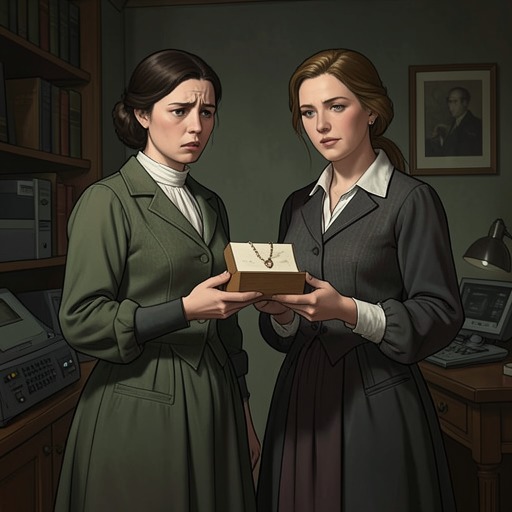
Charlotte Blacklock’s pearl choker
A Murder Is AnnouncedCharlotte Blacklock’s pearl choker conceals the scar from the operation that removed her goitre, helping sustain her impersonation of her sister Letitia. First noticed as jewellery, it becomes a clue whose broken strands prompt questions about its value, while its place around the wearer’s neck ultimately points to the concealed identity beneath the disguise.
Identity and Practical Use
The choker’s defining purpose is established in the account of Charlotte’s illness and treatment. As a young woman, she developed a goitre, and her father, Dr Blacklock, believed that medication rather than surgery was the answer. Charlotte became increasingly withdrawn as the enlargement affected her appearance. After his death, Letitia left her position with Randall Goedler to care for her sister and took her to Switzerland for an operation. The operation succeeded, but left a scar; a choker of pearls or beads could hide it.
That history makes the necklace more than an accessory. Its function depends on what it covers: a visible trace of Charlotte’s earlier illness and the treatment that changed her appearance. In the present, the choker helps Charlotte pass as Letitia, while the mark hidden beneath it remains a means of distinguishing the sisters. The object’s usefulness as disguise therefore also makes it a potential source of exposure.
A Familiar Ornament
The necklace appears within the household as an ordinary, admired piece of jewellery. Dora Bunner draws attention to the brooch pinned to the wearer’s dress, and the woman replies that she is glad Dora likes it, adding that she never cared for jewellery. Dora’s admiration shows how readily the ornament can be read as decoration rather than as a deliberate cover. The difference between its visible role and its private purpose is central to its significance.
Later, as tensions rise, Miss Blacklock stands with a hand at the choker around her neck. The gesture links the ornament to her composure: she clutches at it while insisting that whoever is responsible for the events must be mad. The necklace is not merely part of her appearance in this scene; it is something her hand reaches for under strain, even before its physical break turns it into the focus of the room.
The Broken Pearls and Suspected Value
The choker breaks under Miss Blacklock’s nervous grasp, and its pearls scatter across the room. Letitia cries out over their loss and leaves in distress. The intensity of her response surprises those present, because she has been understood to have no valuable jewellery. Her reaction invites an alternative explanation: perhaps the pearls matter not only as an ornament but because they were given to her by Randall Goedler.
As Phillipa Haymes gathers the scattered beads, she asks whether they might be real. Inspector Craddock initially assumes they are not, but pauses because their size, regularity, and whiteness do not settle the question. He recalls that genuine pearls can sometimes be bought cheaply in a pawnshop. Since Letitia had assured him that the house contained no valuable jewellery, the possibility that these pearls are genuine changes the meaning of her earlier assurance—and raises the possibility that their value could provide a motive for murder if someone knew it.
The scene deliberately leaves the pearls’ worth uncertain. Their appearance seems to argue for imitation, while the circumstances make their possible authenticity consequential. That uncertainty gives the choker a double function in the investigation: it is an emotional object to its wearer and a potential source of wealth to anyone who believes it valuable. The break makes an object that had blended into the household’s routines suddenly visible as evidence and as a question.
The Scar and the Exposure of Identity
The final identification of the wearer resolves the clue in a different direction. When Sergeant Fletcher says that the woman must accompany him, Jane Marple corrects the name being used: the woman is Charlotte Blacklock, not Letitia Blacklock. Marple directs attention to the scar concealed beneath the choker and identifies it as the mark of the goitre operation. The necklace that had enabled the impersonation now points to the identity it was meant to hide.
Its evidentiary force rests on the connection between object and history. The scar alone belongs to Charlotte’s past treatment; the choker makes that scar less visible. But once the investigation understands why the necklace is always worn, concealment itself becomes informative. The ornament does not independently prove the whole deception: Marple’s account supplies the sisters’ history and the operation’s circumstances. Still, the choker joins those facts in a single, legible clue.
Narrative Significance
The choker’s significance develops through a sequence of reversals. It begins as jewellery admired in conversation, becomes a vulnerable possession when it breaks, then appears as a possible fortune, and finally serves as the cover for a scar that reveals Charlotte’s identity. Each new interpretation alters the preceding one: the everyday ornament was never only decoration, and its possible financial value is not the same as its decisive value to the investigation.
The object also holds together two kinds of concealment. It hides the physical trace of the operation, while the wearer’s assumed identity hides the difference between the sisters. Yet the same persistent accessory attracts attention when it breaks and guides the investigator back to the body it was meant to disguise. Its role is therefore both protective and compromising: the choker makes the deception possible, but its connection to the scar helps bring that deception to an end.